Benson's Commentary on the Old and New Testaments
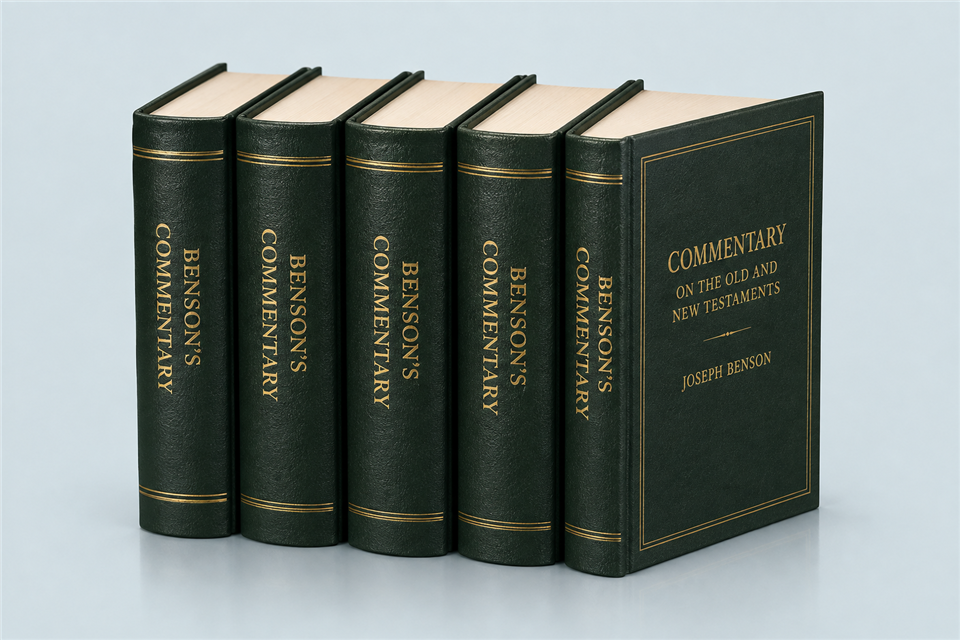
Joseph Benson (1749–1821) was one of the leading Methodist preachers of the generation after John Wesley. Wesley appointed him classical master at Kingswood School in 1766, when Benson was seventeen; in later life he edited the Methodist Magazine and twice served as president of the conference. His commentary was first published between 1811 and 1818 and was a standard commentary in Methodist homes for much of the nineteenth century.
The full title describes the work: the Old and New Testaments "with critical, explanatory, and practical notes," together with marginal readings, a collection of parallel texts, summaries of each book and chapter, and the date of every event according to the chronologers of the day. The SwordSearcher module is taken from the 1857 New York edition published by Carlton and Porter. It covers all sixty-six books in more than 14,000 entries. Each chapter opens with a short outline of its contents, and the Old Testament chapters carry the traditional Ussher dates; Genesis 1 is headed "A.M. 1. B.C. 4004."
Benson draws freely on the commentators who went before him, and he does not hide it. What he adds is a warm, orderly, Wesleyan reading of the text with a constant eye to practical religion. His note on John 3:16 shows both the method and the theology:
For God so loved the world, &c. — Here our Lord proceeds to inform Nicodemus, that men owed the blessings above mentioned to the free and immense love of God the Father, who desired their salvation with such ardency, that he sent his only-begotten Son to bestow it upon them; and that it is designed for all that will accept of it in the way God hath appointed. God, says he, so loved the world, that is, all men under heaven; even those that despise his love, and will for that cause finally perish, that he gave his only-begotten Son, truly and seriously: and the Son of God gave himself, (Ga 2:20,) truly and seriously; that whosoever believeth in him — With that faith which worketh by love, and holdeth fast the beginning of his confidence steadfast to the end; should not perish — Under the sentence of divine justice, as he otherwise must have done; but have everlasting life — The life of grace, and the life of glory, through the mere mercy of God, and the infinite merits of his Son.
Readers who use Wesley's Notes and Clarke's Commentary will find Benson a natural third: fuller than Wesley, more devotional and less technical than Clarke. Sutcliffe is another Methodist commentary of the same period in the library.
This text is part of the SwordSearcher Deluxe Study Library.
Module type: Commentary
Module abbreviation: Benson

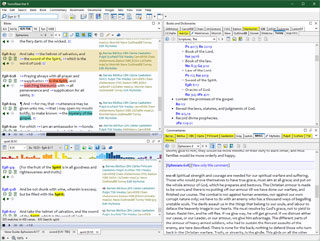
The Deluxe library includes hundreds of volumes. Discover how fast, convenient, and powerful software is compared to mere online study tools.
