A. T. Robertson's Word Pictures in the New Testament
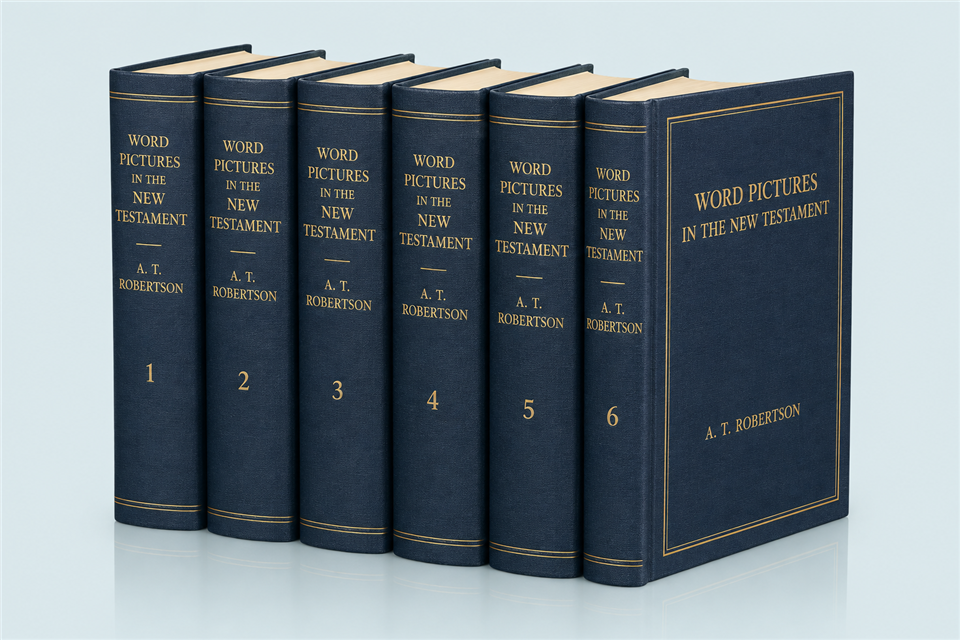
Archibald Thomas Robertson (1863–1934) taught New Testament at the Southern Baptist Theological Seminary in Louisville, Kentucky, for more than forty years. His Grammar of the Greek New Testament in the Light of Historical Research (1914) is still consulted. Word Pictures in the New Testament, published in six volumes between 1930 and 1933, was his attempt to give ordinary Bible readers the fruit of that learning. He taught until the day he died in September 1934.
The plan of the book is in its title. Robertson goes through the New Testament verse by verse and stops wherever he has something to say about the Greek: the tense of a verb, a word with a picture in it, a construction with a particular force. He gives the Greek in English letters, explains the grammar in a sentence or two, and moves on. The note on John 3:16 begins:
For so (houtôs gar). This use of gar is quite in John's style in introducing his comments (Joh 2:25; 4:8; 5:13, etc.). This "Little Gospel" as it is often called, this "comfortable word" (the Anglican Liturgy), while not a quotation from Jesus is a just and marvellous interpretation of the mission and message of our Lord.... Loved (êgapêsen). First aorist active indicative of agapaô, the noble word so common in the Gospels for the highest form of love, used here as often in John (Joh 14:23; 17:23; 1Jo 3:1; 4:10) of God's love for man (cf. 2Th 2:16; Ro 5:8; Eph 2:4).... The world (ton kosmon). The whole cosmos of men, including Gentiles, the whole human race.
That note also shows Robertson making an interpretive judgment: he takes John 3:16–21 as the evangelist's summary of Jesus' teaching rather than as a continuation of Jesus' own words. Some grammatical terms, such as "aorist" and "participle," recur throughout, but they are always tied to the wording of the verse in hand.
The SwordSearcher module covers all twenty-seven books of the New Testament in about 7,200 entries. It is not a devotional commentary and does not try to be; it is the book to open when you want to know what a word means in the Greek and why a translation chose the rendering it did. It pairs naturally with the Strong's lexicons and the King James Version with Strong's links in the library, which let you find the same Greek word everywhere else it occurs.
Two things should be said for readers of the King James Bible. Robertson worked from the critical Greek text of his day rather than from the Received Text underlying the King James Version, so he occasionally comments on a reading that differs from the one in the English text before you. And he was a man of his time and school in his judgments on questions of authorship and date. Neither affects the great bulk of the work, which is careful explanation of the Greek words, but both are worth knowing. The Textus Receptus is in the library for comparison.
This text is part of the SwordSearcher Deluxe Study Library.
Module type: Commentary
Module abbreviation: RWP

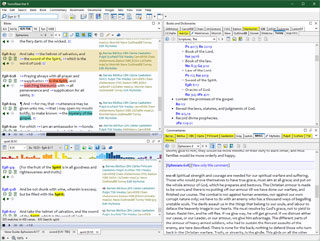
The Deluxe library includes hundreds of volumes. Discover how fast, convenient, and powerful software is compared to mere online study tools.
