F. W. Grant's Bible Notes (The Numerical Bible)
Frederick William Grant (1834–1902) was born in London, emigrated to Canada as a young man, and was ordained in the Church of England in Toronto. Around 1860 he left the Anglican ministry for the Brethren, and he spent the rest of his life teaching and writing among them, first in Toronto and later in Brooklyn and Plainfield, New Jersey.
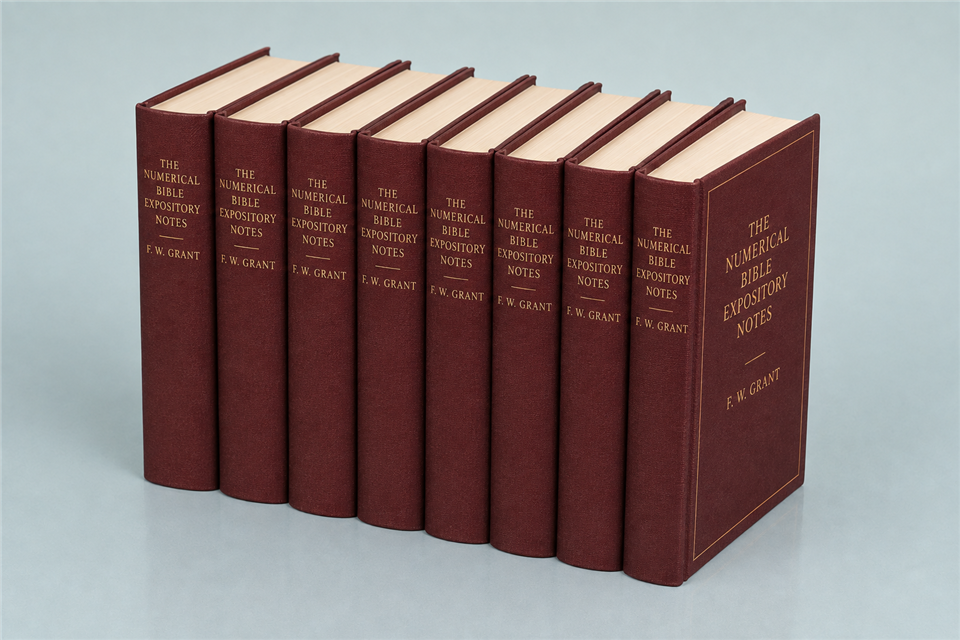
His major work was The Numerical Bible: a revised translation of the Scriptures "with expository notes: arranged, divided, and briefly characterized according to the principles of their numerical structure," as the title page puts it. Grant believed that the books, sections, and even paragraphs of Scripture fall into divisions whose number carries meaning. In his introduction he explains that everything connected with the number one is an application of "the idea of unity, or of primacy," that four "stands as the number of the world, and the symbol for 'weakness' (which may come out in failure), 'trial,' 'experience,'" and that seven is "the well-known symbol of perfection." He organized his exposition around those divisions. Whatever a reader makes of the numerical scheme, the notes underneath it are substantial, Christ-centered, and rich in typology.
The SwordSearcher module contains the notes from the fourth edition (1903), without the translation. Grant did not finish the whole Bible. The notes cover Genesis through 2 Samuel, the Psalms, Ezekiel, and all twenty-seven books of the New Testament. Because they follow his divisions of the text rather than individual verses, each of the 548 entries is attached to the verse where its section begins; every Psalm has one note, for example, and a Gospel chapter may have one or several. Each book opens with an outline of Grant's divisions. The commentary panel's next and previous entry buttons are the easiest way to move through the notes.
His note on the twenty-third Psalm, headed "Salvation in progress," shows his way of reading the Old Testament in the light of Christ:
The apostle prays for the Hebrew Christians to whom he writes, that "the God of peace, who brought again from the dead our Lord Jesus, that great Shepherd of the sheep, through the blood of the everlasting covenant, may make" them "perfect in every good work to do His will." (Heb 13:20-21.) Coming after the story of atonement,—the blood of the everlasting covenant,—we have no difficulty in recognizing Christ, brought again from the dead, as the Divine Shepherd of His people now. Like the latter part of the previous psalm, the present speaks of salvation as the fruit of the Cross. There it was its extensive value, reaching out to the ends of the earth, and from generation to generation upon the earth. Here its value is intensive, affecting the individual life,—comforting, renewing, fortifying the believing soul,—leading it on from present communion with its Saviour-Lord, even amid opposition and hostility, to dwell in Jehovah's house where no power of the enemy can penetrate, no distracting voice can mar the sabbatic rest.
Grant belongs with the other Brethren expositors in the library: Darby, William Kelly, C. H. Mackintosh, F. B. Hole, and Hamilton Smith. His reading of Scripture is dispensational and premillennial.
This text is part of the SwordSearcher Deluxe Study Library.
Module type: Commentary
Module abbreviation: FWGrant

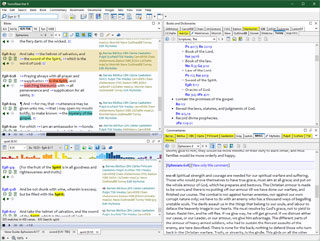
The Deluxe library includes hundreds of volumes. Discover how fast, convenient, and powerful software is compared to mere online study tools.
