Matthew Poole's Commentary on the Holy Bible
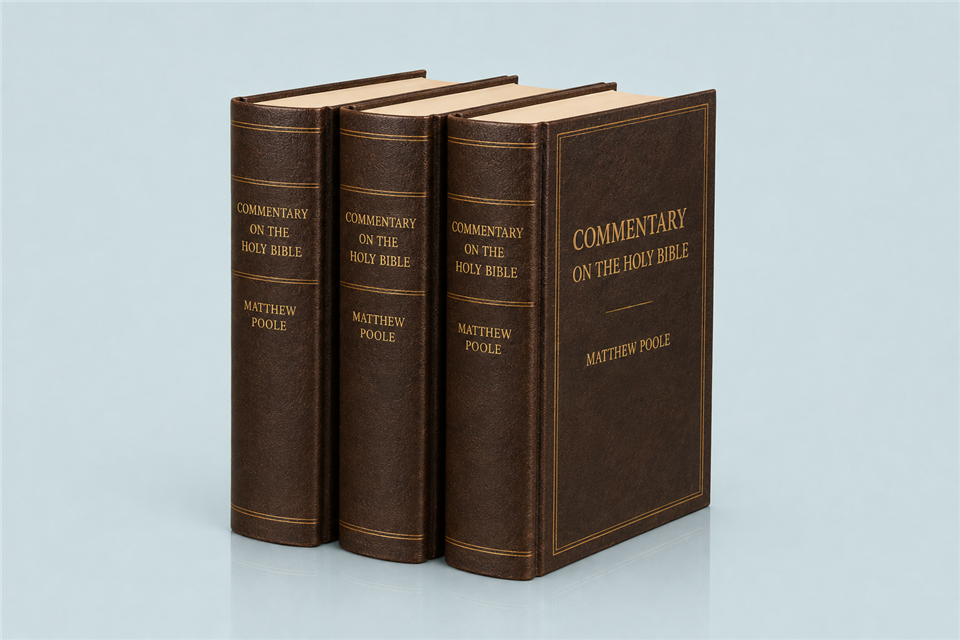
Matthew Poole (1624–1679) was one of the great Puritan scholars. Ejected from his London pulpit in 1662 for nonconformity, he gave the rest of his life to the Scriptures, first producing the five-volume Latin Synopsis Criticorum, a digest of the best commentators of Europe, and then beginning the English Annotations upon the Holy Bible for readers who had no Latin. He had reached Isaiah 58 when he died in 1679, and his friends among the nonconformist ministers finished the work from his plan. It was published in two folio volumes in 1683 and 1685. The notes from Isaiah 59 onward, including the whole New Testament, are therefore not Poole's own, though they follow his method.
Poole explains in his preface why a commentary is needed at all:
God therefore having ceased to speak to men face to face, as to Abraham, and Moses, &c., (which he never ordinarily did but to some particular favourites,) we are by reason enforced to conclude that there are some books in the world in which this revelation is to be found. The church of God (the mother of us all) hath constantly held forth the books of the Old and New Testament (which we have in our Bibles) for this sacred revelation.
The notes are brief, exact, and level-headed. They state the sense of each phrase, give the alternatives where good men differ, and say which is preferred and why, without losing the thread of the passage. Where Matthew Henry preaches, Poole explains. Spurgeon put it this way: "If I must have only one commentary, and had read Matthew Henry as I have, I do not know but what I should choose Poole. He is a very prudent and judicious commentator... not so pithy and witty by far as Matthew Henry, but he is perhaps more accurate, less a commentator, and more an expositor." The handling of "the world" in John 3:16 is a good example of that care:
For God the Father, who is the Lord of all, debtor to none, sufficient to himself, so loved the world, that is, Gentiles as well as Jews. There is a great contest about the signification of the term, between those who contend for or against the point of universal redemption; but certain it is, that from this term no more can be solidly concluded, than from the terms all and every, which in multitudes of places are taken in a restrained sense for many, or all of such a nation or kind.
The SwordSearcher module contains the complete Annotations on all sixty-six books, with more than 24,000 entries and an argument, or summary, at the head of each chapter. The standpoint is that of the Westminster Puritans. Readers who use Matthew Henry and John Gill will find Poole the natural third member of that company: shorter than either, and often the clearest of the three on a difficult verse.
This text is part of the SwordSearcher Deluxe Study Library.
Module type: Commentary
Module abbreviation: Poole

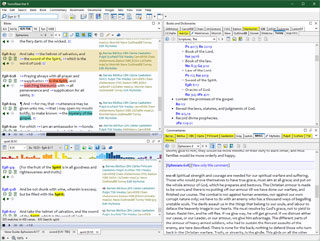
The Deluxe library includes hundreds of volumes. Discover how fast, convenient, and powerful software is compared to mere online study tools.
