SwordSearcher 10: Searching the Bible Without Knowing the Words

Watch the video here.

Keyword search has been the foundation of Bible software for decades. It’s powerful, precise, and indispensable for serious study. But it has a fundamental limitation: you have to already know the words you’re looking for.

This is a real barrier for people who are new to the Bible. The Bible has a specialized vocabulary that a new reader will not be familiar with. If you want to find verses about being anxious, it is difficult to form a keyword search that finds “Philippians 4:6 Be careful for nothing; but in every thing by prayer and supplication with thanksgiving let your requests be made known unto God.” or “1 Peter 5:7 Casting all your care upon him; for he careth for you.”

Even experienced readers run into this. You remember the idea of a passage but not the phrasing. You know the concept you want to study but aren’t sure which terms the Bible uses to express it. You end up trying keyword after keyword, hoping to land on the right one, then resort to Commentaries or Dictionaries.

SwordSearcher 10 introduces natural language Bible search to address this directly. Instead of keywords, you describe what you’re looking for in plain language — a concept, a feeling, a half-remembered idea — and SwordSearcher finds the verses that match the meaning of what you typed.

Search for “morning thoughts” and find Psalm 5:3: “My voice shalt thou hear in the morning, O LORD; in the morning will I direct my prayer unto thee, and will look up.” That’s not a result keyword search can give you, because the words “morning” and “thoughts” don’t appear together in the verse. But it’s a perfect match. You’ll also find “Psalm 143:8 Cause me to hear thy lovingkindness in the morning; for in thee do I trust: cause me to know the way wherein I should walk; for I lift up my soul unto thee.”

This doesn’t replace keyword search. Precision still matters, and when you know what you’re looking for, or are in a deep study, nothing beats an exact search. Natural language search is a complement — a way in for the reader who doesn’t yet have the vocabulary, and a way forward for the reader who knows what they mean but not how to say it.

I’ve been building Bible software for over thirty years, and thinking about this problem for at least twenty of them. I’m glad to have finally shipped a solution. I hope you find it edifying.
Watch the video here.

New video: Putting Bible verses into historical context

It can be interesting and useful to learn when a particular event in the Bible occurred or was written. SwordSearcher includes two resources that are very helpful with this. Head on over to this new video: Putting Bible Verses into Historical Context

The video demonstrates how the Treasury of Scripture Knowledge and the Annals of the World (by James Usher) can provide calendar dates and historical context.

Updated video: Making your own books and commentaries

SwordSearcher has long offered the ability to create your own content in the library. This functionality has steadily been improved with new features and tools. Version 8.2, released last week, improves the editor by live-linking verse references as you type. Up until 8.2, verse references were only linked when the entry was saved. This worked well, but now you can make changes and additions and verify that the references are correct before saving the entry. This and other changes over the years prompted me to update (well, completely re-do) the tutorial video on user modules which you can now watch here.

New video quick-tip: Custom Search Ranges

Normally, a whole-Bible search will find what you are looking for in a snap.

But sometimes, you’ll want to narrow things down a bit.

This video shows how you can use the Search Bible window to specify any arbitrary portion of Scripture as your search range, so you can limit the search results to any section or sections of the Bible you choose.

Watch the video here.

Tips for Using SwordSearcher with Multiple Monitors

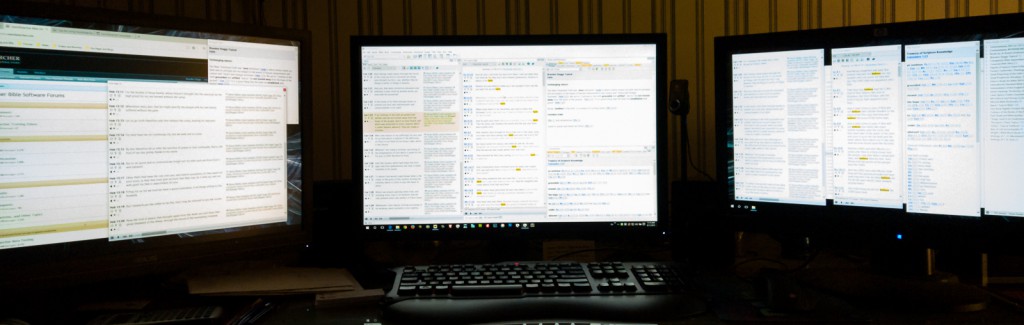
I am often asked how SwordSearcher can be used with multiple monitors. The most common question is whether or not the individual panels can be moved to separate monitors.

Yes!

20150811-11-15-41-001

SwordSearcher’s layout system is very powerful and highly configurable.

The secret is to enable layout customization on the View menu (or on the layout toolbar drop-down menu). Doing that will put your SwordSearcher layout into a true power-user mode, where you can move the panels around your screen, change where they are docked, and even put panels on different monitors. Then, you can use the save layout function to save your new layout to make it easy to go right back to it any time.

The Customizing the Layout Video demonstrates the details. Take a look!

If you are really adventurous, you may want to experiment with an advanced feature called “auto hide,” which will slide panels off to the edge when you are not using them. It’s disabled by default, and I only recommend this for advanced users. You can read how to use it in the help file here. Have fun!

Using the Find Related Verses tool (video)

Cross-referencing is the most powerful and reliable method of understanding verses, because it allows the Bible to speak for itself.

SwordSearcher contains many tools to enable comparison of Scripture with Scripture.

One of these is the Find Related Verses tool. This video demonstrates how you can use this feature to develop your own cross-references on any passage.

Watch the video here.